TRUE COLORS
David Pagel: On Richard Roth's Paintings
Playfulness—and the realities it generates—also animate Roth’s boxy paintings. Like Hutchison’s, his crisply delineated compositions make you wonder what you’re looking at: a painting? five separate paintings, each facing a different direction? a single surface wrapped around an invisible armature? the lovechild of a painting by Mondrian and a set of Lego building blocks? a smartly configured diagram that has been streamlined and stylized and inflated, so that it has become a three-dimensional chunk of impossible-to- name ambiguity? a wall-mounted sculpture? part of the architecture? a solid volume whose exterior shapes seem to go all the way through, in a quasi-geological fashion, forming single-colored bands, bars, and zig-zags? an impenetrable mystery whose surface is adorned with geometric patterns that dance off on their own, free from the restrictions of three-dimensional reality and picking up speed when they cut around the corners of the objects they animate? Like Johnson’s canvases, Roth’s seriously whimsical works form wholes that are greater than the sum of their parts. Their synergies generate viewer participation: Your body has to move—left and right, up and down, back and forth—to even begin to see what’s in front of you. And your mind has to move a lot more fluidly and flexibly and multi-directionally if you’re going to come to terms with the confounding complexity of Roth’s deviously generous works.
- David Pagel, 2021 - Excerpted from the catalogue essay for Chromatic, the group exhibition at the Bentley Gallery, Phoenix, Arizona
- David Pagel is an art critic who writes regularly for the Los Angeles Times. He is a professor of art theory and history at Claremont Graduate University and an adjunct curator at the Parrish Art Museum in Water Mill, NY.
****************************************************************************
STEPHEN WESTFALL: On Richard Roth's Paintings
Richard Roth is making a welcome return to painting after a more than ten year hiatus, during which he pursued collecting and archiving various examples of what might be called “vernacular modernism,” such as commercial paint color charts, blank filing forms, and women’s compact mirrors displayed with the lid open. His reconsideration of abstract painting is visible through the lens of his collecting activities: his small box-like format constitutes a more tangible object than the shallower projection of a conventional panel or stretched canvas. The deeper sides of the boxes are wide enough to constitute another pictorial plane, which Roth exploits by extending the composition around to the sides while making sure that the pictorial “event” is echoed on each side. The image is abstract, a structurally essential embedding of figure into ground that changes from painting to painting and which can be defined by a curve, a diamond, or a plane bracketed by taut bands running along the edges, on the sides, and top. This is an objectified space, what we call “iconic,” and Roth’s paintings are unusual in that this iconic space is fulfilled on three sides. We can add Roth’s current body of work to certain Mary Heilmann paintings and Jo Baer’s early canvases as being among the few paintings that make the sides pictorially vital.
Roth’s pictorial compositions seem extrapolated from memories of the world, fragments of something seen: side furniture and architectural ornament, packaging, even masks and the contours of the body. They are geometric, nearly minimal, but always quiver with this sense of being sourced elsewhere. The colors, too, seem to come from another place, as rich and vibrant as they are: the world of worn signs, perhaps. This sense of the work having traveled is odd because of the pristine beauty of their execution. Roth has always been a wonderful painter and he exhibits an elegant touch in his new paintings with Flashe acrylic, a paint of brilliant color that dries matte to an effect that is more like gouache. Roth describes the paintings as “aphoristic,” like quips or snatches of conversation that expand in the mind. Their objecthood and their internal compositional variety across a regulated format suggest that Roth sees this body of work as connected to his collecting and curatorial activities of the last decade, as though he’s curating a “collection” of object/paintings that meet a certain set of criteria.
This is not a dispassionate process, just smart. It’s the “Self” observing itself having a conversation with the motivating culture of the “Self.” Since Mondrian, one wing of abstract art has largely been a Talmudic commentary on exposed indexical and syntactical operations, and on influence. Thus it joins material craft with philosophy. We can see Mondrian, Kelly, early Stella, Myron Stout, Blinky Palermo, and Moira Dryer in Roth’s conversation, but the important thing is that his art has its own character: exacting, circumspect, and humorous. Roth holds his own in this high flying company. His touch, color, sense of scale, and general exquisiteness are felt as an original contribution, not just to discourse, but the pleasure we take from well crafted form and image.
- Stephen Westfall, 2007 - from the introduction to the Richard Roth exhibition at Reynolds Gallery
- Stephen Westfall is a painter, art critic, contributing writer for Art in America, and faculty member at the Mason Gross School of the Arts, Rutgers University. He has exhibited in the United States and abroad for over a decade, showing at Lennon Weinberg Gallery, Galerie Zurcher, and Galerie Paal. His work can be found in numerous public collections. He is the recipient of fellowships from the National Endowment for the Arts, the New York State Council of the Arts, and the Guggenheim Foundation. In addition to Art in America, his writings have appeared in The New York Times, Arts, Art News, the Partisan Review, and the New Criterion. He holds an M.F.A. from the University of California, Santa Barbara and has taught at Bard College and the School of Visual Art.
*************************************************************************************
PAINTING THE SENSE OF THINGS
SAUL OSTROW: On Richard Roth's New Paintings
This exhibition marks Richard Roth’s return to painting.
Having started as a painter, then having explored that
ambiguous terrain of assemblage that constitutes a
synthesis of the best aspects of formalist painting and
sculpture, Roth proceeded to abandon painting
altogether to explore the conceptual and aesthetic
capacity rooted in the readymade world of visual and
material culture. During this later period, his primary
activity was the assembling of collections of such
edifying artifacts as color charts, compacts, targets,
and legal forms. In other words, Roth has spent a
significant part of his professional life trying to escape
the gravity of paint on canvas only now to be pulled
back into its orbit.
Roth has come to the realization that “paintings are
cunning artifacts that can alter perception, and create
new narratives.” What is interesting about this statement
is that it is not a refutation of his previous concerns,
nor that of Post-Modernism, which asserted that
painting was dead. Instead, these two goals constitute
criteria by which what is possible (using anything to
make art) and what may be necessary (changing our
awareness) are to be judged. Given this proposition,
the quote constitutes a manifesto reflecting a repositioning
of art, and with it, painting’s function. This
radical interpretation may be the rationale for a con-
servative turn, or inversely, it could represent an act
of resistance against the standardized and repetitive
narratives of contemporary art and the ersatz products
of the entertainment industry.
Whatever the conscious intent of Roth’s thinking, it
none-the-less is premised on the view that art
(specifically abstract art) may aesthetically embody a
politic concerned with the totality of interrelationships
involving our relationship to power, authority, and our
sense of self. This politic resides in art’s ability to
confront us with the unfamiliar in the sense that it can
be used to challenge those expectations and conventions
which are associated with intellectual and
aesthetic complacency. This view is founded on a belief
that on the level of individual experience, abstract art, as
phenomena to be made sense of – rather than an
unpacking of literary contents – requires engagement.
For some this appeal to the primacy of experience and
self-reflection offers the possibility of creating models
of “self,” engagement, and “agency” within a cultural
environment committed to the spectacle of mass media.
As such, one’s encounter with abstract art may bridge
and inform our understanding of the differing agendas
that form our trajectory across the numerous
territories and environments of everyday life.
By re-engaging painting’s geometric tradition, Roth
positions himself within a network of influences that
reflect Modernism’s systemic, industrial aesthetic,
which over the course of the 20th century was
promoted by Piet Mondrian, Rodchenko, Ad Reinhardt,
Ellsworth Kelly, Myron Stout, Jo Baer, as well as Imi
Knoebel, Blinky Palermo, and Peter Halley. Grasping
the significant changes that have taken place within
art’s function and criteria, Roth acknowledges the
differing goals and affects of these practices, rather than
their similarities. Roth finds the impetus for his project
not only in previously understated, unacknowledged
or prescient practices of modernism, but also in its
conventions. By working in series that are intuitively,
rather than systemically ordered, he investigates how
many different ways a given affect may be created or
deployed. The subtle “pop” references to contemporary
design, and his choice of color lend the work a degree
of aesthetic accessibility as well as a sense of humor.
In privileging form, physicality, and opticality over painterly
process and a desire to give representation to his
personal reality, the consequences of Roth’s approach
are two-fold. First, though the series he works in begins
with a set of parameters (primarily, those of format)
and the images are often variants of one another’s
general characteristics – each painting’s composition or
identity is pre-ordained. The second is that rather
than producing a group of individuated objects joined
by style or sensibility this series represents an investigation
into the multiple aspects of opticality via form,
composition, structure, limited palette – two colors,
single image. What is important is that the series gains
specificity by recording not the artist’s decision-making
process but the variants (and options) that will fulfill
imagistically (design) structurally (materially) and
phenomenologically (perceptually) his functional criteria.
The resulting paintings therefore rather than being
objects are assemblages of literal and structural events
that unfold in real time.
Though the work may be reductive and mechanically
severe in appearance, Roth transforms the Modernist
abandonment of craft into something positive. What had
once been an aspect of a nihilist impulse, in these works
becomes part of a process meant to resist any further
concessions in the direction of the arbitrary. By
challenging both his own and the viewer’s subjectivity,
Roth orders an “encounter” via his paintings, which is
the result of more than a random conglomerate of
effects, conventions and simulations. The importance of
Roth’s phenomenology (the painting as an event) and as
a material proposition (as an assemblage with its own
internal logic) renders up a discourse that illuminates
the variety of markers by which we establish correlations
between experience, memory, consciousness
and the things and processes that initiate them.
Gratification is consequently neither purely aesthetic
nor intellectual but lies in the intersection of the two.
Roth’s emergent practice, therefore, can be understood
to focus on how the subject-hood of such a simple thing
as a painted object depends on the complex economy
that exists between things, their reception. The
illusionism that Roth employs effectively causes the
object/painting’s appearance to dramatically change
as the observer discovers the true nature of the work
in time. This permits them to occupy the interface
between the modernist reductive “object” and speculative
assertions concerning function. As a group
of objects, each painting acts in concert with the other
to generate an embodied sensory (aesthetic) moment,
unmarked by conflict or despair. This permits the viewer
to take pleasure in engaging both the object and
his/her own self-reflectivity. Consequently, the model
of art that Roth articulates depends on the broad-range
of concepts we employ to give order, structures
and meaning to the phenomenon and experiences that
make up our perceived world. In this, he induces
us to make sense of the existent order of things
as well as our preconceptions.
- Saul Ostrow, 2007, from the introduction to the Richard
Roth exhibition Cowboy Magic at the Lamar Dodd School of
Art Main Gallery, The University of Georgia
- Saul Ostrow is an art critic and former Chair of Visual Arts and
Technologies at The Cleveland Institute of Art. Trained
as an artist, he is best known as a critic and curator,
having curated over 80 exhibitions since 1985. He is a
contributing author to various arts publications, and is
art editor for BOMB Magazine as well as the editor for the
book series Critical Voices in Art, Theory and Criticism,
published by Routledge, UK.
*************************************************************************************
David Pagel: On Richard Roth's Paintings
Playfulness—and the realities it generates—also animate Roth’s boxy paintings. Like Hutchison’s, his crisply delineated compositions make you wonder what you’re looking at: a painting? five separate paintings, each facing a different direction? a single surface wrapped around an invisible armature? the lovechild of a painting by Mondrian and a set of Lego building blocks? a smartly configured diagram that has been streamlined and stylized and inflated, so that it has become a three-dimensional chunk of impossible-to- name ambiguity? a wall-mounted sculpture? part of the architecture? a solid volume whose exterior shapes seem to go all the way through, in a quasi-geological fashion, forming single-colored bands, bars, and zig-zags? an impenetrable mystery whose surface is adorned with geometric patterns that dance off on their own, free from the restrictions of three-dimensional reality and picking up speed when they cut around the corners of the objects they animate? Like Johnson’s canvases, Roth’s seriously whimsical works form wholes that are greater than the sum of their parts. Their synergies generate viewer participation: Your body has to move—left and right, up and down, back and forth—to even begin to see what’s in front of you. And your mind has to move a lot more fluidly and flexibly and multi-directionally if you’re going to come to terms with the confounding complexity of Roth’s deviously generous works.
- David Pagel, 2021 - Excerpted from the catalogue essay for Chromatic, the group exhibition at the Bentley Gallery, Phoenix, Arizona
- David Pagel is an art critic who writes regularly for the Los Angeles Times. He is a professor of art theory and history at Claremont Graduate University and an adjunct curator at the Parrish Art Museum in Water Mill, NY.
****************************************************************************
STEPHEN WESTFALL: On Richard Roth's Paintings
Richard Roth is making a welcome return to painting after a more than ten year hiatus, during which he pursued collecting and archiving various examples of what might be called “vernacular modernism,” such as commercial paint color charts, blank filing forms, and women’s compact mirrors displayed with the lid open. His reconsideration of abstract painting is visible through the lens of his collecting activities: his small box-like format constitutes a more tangible object than the shallower projection of a conventional panel or stretched canvas. The deeper sides of the boxes are wide enough to constitute another pictorial plane, which Roth exploits by extending the composition around to the sides while making sure that the pictorial “event” is echoed on each side. The image is abstract, a structurally essential embedding of figure into ground that changes from painting to painting and which can be defined by a curve, a diamond, or a plane bracketed by taut bands running along the edges, on the sides, and top. This is an objectified space, what we call “iconic,” and Roth’s paintings are unusual in that this iconic space is fulfilled on three sides. We can add Roth’s current body of work to certain Mary Heilmann paintings and Jo Baer’s early canvases as being among the few paintings that make the sides pictorially vital.
Roth’s pictorial compositions seem extrapolated from memories of the world, fragments of something seen: side furniture and architectural ornament, packaging, even masks and the contours of the body. They are geometric, nearly minimal, but always quiver with this sense of being sourced elsewhere. The colors, too, seem to come from another place, as rich and vibrant as they are: the world of worn signs, perhaps. This sense of the work having traveled is odd because of the pristine beauty of their execution. Roth has always been a wonderful painter and he exhibits an elegant touch in his new paintings with Flashe acrylic, a paint of brilliant color that dries matte to an effect that is more like gouache. Roth describes the paintings as “aphoristic,” like quips or snatches of conversation that expand in the mind. Their objecthood and their internal compositional variety across a regulated format suggest that Roth sees this body of work as connected to his collecting and curatorial activities of the last decade, as though he’s curating a “collection” of object/paintings that meet a certain set of criteria.
This is not a dispassionate process, just smart. It’s the “Self” observing itself having a conversation with the motivating culture of the “Self.” Since Mondrian, one wing of abstract art has largely been a Talmudic commentary on exposed indexical and syntactical operations, and on influence. Thus it joins material craft with philosophy. We can see Mondrian, Kelly, early Stella, Myron Stout, Blinky Palermo, and Moira Dryer in Roth’s conversation, but the important thing is that his art has its own character: exacting, circumspect, and humorous. Roth holds his own in this high flying company. His touch, color, sense of scale, and general exquisiteness are felt as an original contribution, not just to discourse, but the pleasure we take from well crafted form and image.
- Stephen Westfall, 2007 - from the introduction to the Richard Roth exhibition at Reynolds Gallery
- Stephen Westfall is a painter, art critic, contributing writer for Art in America, and faculty member at the Mason Gross School of the Arts, Rutgers University. He has exhibited in the United States and abroad for over a decade, showing at Lennon Weinberg Gallery, Galerie Zurcher, and Galerie Paal. His work can be found in numerous public collections. He is the recipient of fellowships from the National Endowment for the Arts, the New York State Council of the Arts, and the Guggenheim Foundation. In addition to Art in America, his writings have appeared in The New York Times, Arts, Art News, the Partisan Review, and the New Criterion. He holds an M.F.A. from the University of California, Santa Barbara and has taught at Bard College and the School of Visual Art.
*************************************************************************************
PAINTING THE SENSE OF THINGS
SAUL OSTROW: On Richard Roth's New Paintings
This exhibition marks Richard Roth’s return to painting.
Having started as a painter, then having explored that
ambiguous terrain of assemblage that constitutes a
synthesis of the best aspects of formalist painting and
sculpture, Roth proceeded to abandon painting
altogether to explore the conceptual and aesthetic
capacity rooted in the readymade world of visual and
material culture. During this later period, his primary
activity was the assembling of collections of such
edifying artifacts as color charts, compacts, targets,
and legal forms. In other words, Roth has spent a
significant part of his professional life trying to escape
the gravity of paint on canvas only now to be pulled
back into its orbit.
Roth has come to the realization that “paintings are
cunning artifacts that can alter perception, and create
new narratives.” What is interesting about this statement
is that it is not a refutation of his previous concerns,
nor that of Post-Modernism, which asserted that
painting was dead. Instead, these two goals constitute
criteria by which what is possible (using anything to
make art) and what may be necessary (changing our
awareness) are to be judged. Given this proposition,
the quote constitutes a manifesto reflecting a repositioning
of art, and with it, painting’s function. This
radical interpretation may be the rationale for a con-
servative turn, or inversely, it could represent an act
of resistance against the standardized and repetitive
narratives of contemporary art and the ersatz products
of the entertainment industry.
Whatever the conscious intent of Roth’s thinking, it
none-the-less is premised on the view that art
(specifically abstract art) may aesthetically embody a
politic concerned with the totality of interrelationships
involving our relationship to power, authority, and our
sense of self. This politic resides in art’s ability to
confront us with the unfamiliar in the sense that it can
be used to challenge those expectations and conventions
which are associated with intellectual and
aesthetic complacency. This view is founded on a belief
that on the level of individual experience, abstract art, as
phenomena to be made sense of – rather than an
unpacking of literary contents – requires engagement.
For some this appeal to the primacy of experience and
self-reflection offers the possibility of creating models
of “self,” engagement, and “agency” within a cultural
environment committed to the spectacle of mass media.
As such, one’s encounter with abstract art may bridge
and inform our understanding of the differing agendas
that form our trajectory across the numerous
territories and environments of everyday life.
By re-engaging painting’s geometric tradition, Roth
positions himself within a network of influences that
reflect Modernism’s systemic, industrial aesthetic,
which over the course of the 20th century was
promoted by Piet Mondrian, Rodchenko, Ad Reinhardt,
Ellsworth Kelly, Myron Stout, Jo Baer, as well as Imi
Knoebel, Blinky Palermo, and Peter Halley. Grasping
the significant changes that have taken place within
art’s function and criteria, Roth acknowledges the
differing goals and affects of these practices, rather than
their similarities. Roth finds the impetus for his project
not only in previously understated, unacknowledged
or prescient practices of modernism, but also in its
conventions. By working in series that are intuitively,
rather than systemically ordered, he investigates how
many different ways a given affect may be created or
deployed. The subtle “pop” references to contemporary
design, and his choice of color lend the work a degree
of aesthetic accessibility as well as a sense of humor.
In privileging form, physicality, and opticality over painterly
process and a desire to give representation to his
personal reality, the consequences of Roth’s approach
are two-fold. First, though the series he works in begins
with a set of parameters (primarily, those of format)
and the images are often variants of one another’s
general characteristics – each painting’s composition or
identity is pre-ordained. The second is that rather
than producing a group of individuated objects joined
by style or sensibility this series represents an investigation
into the multiple aspects of opticality via form,
composition, structure, limited palette – two colors,
single image. What is important is that the series gains
specificity by recording not the artist’s decision-making
process but the variants (and options) that will fulfill
imagistically (design) structurally (materially) and
phenomenologically (perceptually) his functional criteria.
The resulting paintings therefore rather than being
objects are assemblages of literal and structural events
that unfold in real time.
Though the work may be reductive and mechanically
severe in appearance, Roth transforms the Modernist
abandonment of craft into something positive. What had
once been an aspect of a nihilist impulse, in these works
becomes part of a process meant to resist any further
concessions in the direction of the arbitrary. By
challenging both his own and the viewer’s subjectivity,
Roth orders an “encounter” via his paintings, which is
the result of more than a random conglomerate of
effects, conventions and simulations. The importance of
Roth’s phenomenology (the painting as an event) and as
a material proposition (as an assemblage with its own
internal logic) renders up a discourse that illuminates
the variety of markers by which we establish correlations
between experience, memory, consciousness
and the things and processes that initiate them.
Gratification is consequently neither purely aesthetic
nor intellectual but lies in the intersection of the two.
Roth’s emergent practice, therefore, can be understood
to focus on how the subject-hood of such a simple thing
as a painted object depends on the complex economy
that exists between things, their reception. The
illusionism that Roth employs effectively causes the
object/painting’s appearance to dramatically change
as the observer discovers the true nature of the work
in time. This permits them to occupy the interface
between the modernist reductive “object” and speculative
assertions concerning function. As a group
of objects, each painting acts in concert with the other
to generate an embodied sensory (aesthetic) moment,
unmarked by conflict or despair. This permits the viewer
to take pleasure in engaging both the object and
his/her own self-reflectivity. Consequently, the model
of art that Roth articulates depends on the broad-range
of concepts we employ to give order, structures
and meaning to the phenomenon and experiences that
make up our perceived world. In this, he induces
us to make sense of the existent order of things
as well as our preconceptions.
- Saul Ostrow, 2007, from the introduction to the Richard
Roth exhibition Cowboy Magic at the Lamar Dodd School of
Art Main Gallery, The University of Georgia
- Saul Ostrow is an art critic and former Chair of Visual Arts and
Technologies at The Cleveland Institute of Art. Trained
as an artist, he is best known as a critic and curator,
having curated over 80 exhibitions since 1985. He is a
contributing author to various arts publications, and is
art editor for BOMB Magazine as well as the editor for the
book series Critical Voices in Art, Theory and Criticism,
published by Routledge, UK.
*************************************************************************************
Essay from the catalogue of the Highland Institute of Contemporary Art, Loch Ruthven, Scotland—“Exhibitions 2011”
In response to Richard Roth’s HICA exhibition, Vernacular Modernism, 1 May - 5 June 2011.
Beyond the Shadow of Doubt
By Colin Glen

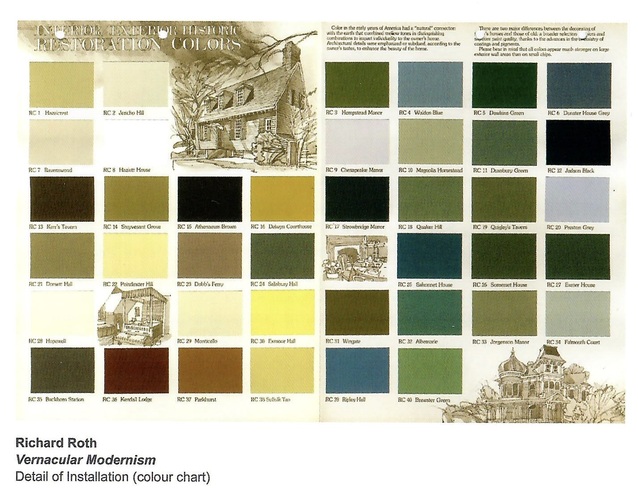
‘Pink Hibiscus, Dainty Peach, Lilac Mist, Serenity, Celestial Yellow, Veil...' read the captioned labels below the swatches in a section of one of Richard Roth's home decorating paint colour charts, the True Test Ultra Satin range, to be precise. And as your eyes wander around the comfortable stove-warmed front room at
HICA, glancing over the selection of simply arranged unframed charts such as The Frank Lloyd Wright Collection placed, indeed, above The Authentic Painted Ladies Collection you become aware of a mounting sense of doubt: In spite of a prior familiarity with the re-presentation of found ephemera over the course of modern art which has employed the methodology of museum curatorship, Roth's deadpan delivery, seasoned with wry humour, strips your faith back to its bare bones that such material could be worthy of critical attention. On turning to the exhibition's supplementary text we read that this experience is a strategic part of Roth's approach - a 'gentle puncturing' of the pomposity of modern art movements. The artist, however, is no stranger to such movements, having taught art for three decades he is currently Professor of Painting and Printmaking at Virginia Commonwealth University and in his lecture Collecting Myself - published on his website - he outlines the genealogy of those artists whose practice has involved the collecting of ephemera. Most apt is his reference to Gerhard Richter whose project Atlas - a collection of over 2800 photographic images derived from secondary source material - such as popular magazines - was begun in 1962. It is Richter's Colour Charts series - begun in 1966 - which bears most direct visual relation to Roth's investigations but it is in their differences that the fundamental drive behind Roth's work is revealed. Richter's motivation for his paintings was 'more to do with Pop Art. They were copies of paint sample cards, and what was effective about them was that they were directed against the efforts of the Neo-Constructivists, Albers and the rest. For Roth, the blank presentation of the colour charts as sovereign objects is a deflation of the authority of art accompanied by the intention that the place of origin of the charts, vernacular culture, be appreciated in its own right. However, despite his avowed 'reverence for "ordinary objects” ’, he employs doubt as a kind of methodology (that drive of the collector - whose acquisition, ordering and classification of ephemeral material shores up against the flux of things) to prevent exalting such objects to art status. Instead he permits them to remain as the detritus of 'everyday culture'- manifesting 'a belief that mass culture is the living, indigenous culture of the post-industrial world.’ To this end Roth quotes Ralph Waldo Emerson ‘I ask not for the great, the remote, the romantic, I embrace the common, I explore and sit at the feet of the familiar, the low.’ In a sense, then, the vernacular is a kind of antidote, a healing process for the erosive effect of the over-cultured art world that sponsors a rash of over-signification of the everyday.
Casting our gaze over to the large picture window with its view of the glassy surface of Loch Ruthven beyond, we notice the discreet placing of two colour charts alongside the scene, as if to caption it as an image. Accompanying the saturated and intensified colour photographs of mountains and lakes that pun on the view, the text declares 'the goal of life is living in agreement with nature'. The apparent irony of Roth's gesture, which juxtaposes the hyperbolic cultural artefact with the gently prosaic reality, dissolves on reflection that Roth is not concerned with using art as polemic for nature - but with learning about our own human nature, through familiarity with the 'small and low' in both the natural and man-made world. This approach is surely the great contribution of American culture to modern times, through Henry Thoreau, Ralph Waldo Emerson and William Carlos Williams.Snapping our attention back into the room, away from the charms of the Highland scene, we are drawn like the prisoners in Plato's cave attempting to make sense of shadows cast from reality, to the back wall which bears a temporarily tacked-up grid of official-looking paper forms. On closer inspection the blank documents range in subject from hospital notes and psychological profile questionnaires to vote registration and fast food order forms - a sample map of the human urge to collect data in order to organise the world.
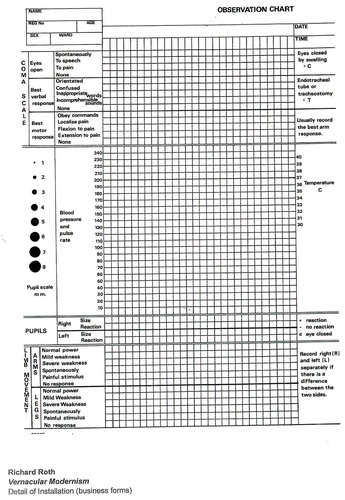
The forms are echoes of personal narratives, the attempt to tidy up the messiness of the personal, the subjective, in short, the human. However, the unwritten lines
- accompanied by the implication that this grid is merely a tiny extract from the volume of documents that exist to annotate the particulars of our presence - only goes to induce the overwhelming, and in some cases unbearable, absence of the human subjects that are potentially referred to. Roth's spartan presentation of such found material stands as witness to absence - beyond its referential function as a representational sign of the modernist 'grid' exemplified by Piet Mondrian or Agnes Martin. Roth sees the trope of the grid as 'a cage’ that symbolises the dark side of modernism' or 'a prison' within which the contingency of personal narratives cannot be contained - speaking more about the indeterminacy of human nature than all the expressivity of indexical mark-making. It is the notion of questioning raised in and by the forms that is crucial to the reinvigorating of subjectivity, as the imagination is aroused by the sense of possibility. Who is the person, for instance, who would return a highest score of '3' in answer to probing about obsessive disorders? Or most poignantly respond to the trauma of 9/11?
Gently, our stance of cold detachment in the registering of the taxonomic display of the documents undergoes a gradual thawing, enlisting our empathy towards the imagined subject. And so it becomes intriguing that the only form to bear a representational element is the familiar graphic of the face on the Elizabeth Arden make up form, surely we feel, beyond the pale for a 'serious' art context. But one could say that it is precisely the engagement with this image that releases us from the tyranny of the modernist grid, like the prisoners freed from Plato's Cave to witness first shadow, then reflection and finally the sun, through an acceptance of our self-reflexive nature. The Arden make-up form speaks of our innate need to transform ourselves from within, to construct ourselves through representation, to 'make ourselves up.’ The residual belief that you can make anew transcends the post-modern impasse of doubt - manifest as the ironic repetition of cultural forms as empty gesture - of forms such as the grid. Hence Roth's 'reverence for the vernacular' is not a permanent annexing of the everyday into the dominion of art, but allowing it instead not to be art; holding it in temporary parenthesis - as briefly translated into the language of art. During the Sunday morning discussion event for Vernacular Modernism at HICA, Roth declared the value of the quotidian to be the potential to make anew - shown in his admiration for the car paint sprayer, the make-up artist and the chef saying he would rather 'a first-rate soup to a second-rate painting'.
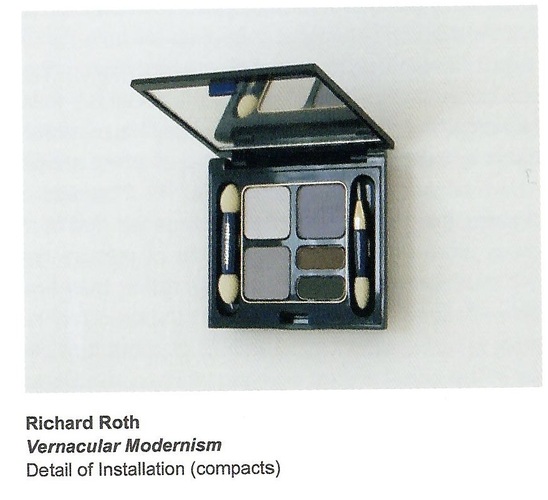
The shadow of doubt passes, in favour of specular reflection as we move on into the quiet intimacy of HICA's smaller gallery space. This room is the culmination of Roth's show, as the objects, eye-shadow compacts, are arranged at precisely regular intervals along each wall, one in a line, the other a grid of two lines, that cause the tiny little colour samples to glow with the luminosity of jewels. Here we must defer to Roth's own commentary for a moment:
‘Twenty Eye-Shadow Compacts, is directly involved with abstract painting, especially monochrome painting. Compacts contain rich, matte surfaces of pure dense pigment in magical little containers. Miniature Rothkos you can hold in your hand, or your handbag… These compacts are also about an idealized human form, and like portrait painting, involve a ritualized activity in which pigment on a palette is applied with a brush with great care in a personal style. Makeup and portraiture are meditations on beauty and identity created in private for exhibition in public.’
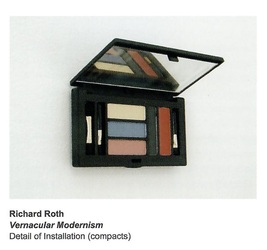
In an apparent paradox Roth uses the conventions of gallery-based presentation to show the compacts as discreet objects in themselves - detached from the constant movement of the everyday world. And although the objects are seen literally and metaphorically without frames, the gallery itself acts as a kind of viewing frame to lend them the sense of being a 'concrete' art object - particularly apt considering HICA's agenda to investigate the legacy of the concrete in contemporary art. Roth's installation declares his faith in mass culture - he consciously eschews postmodern readings of the insidious effects of consumerism on art and culture in favour of an acceptance (but not through tropes of re-presentation in the manner of Pop art) of the object as continuing to remain part of the everyday world. He arranges the compacts at a height that they could conceivably be used for making-up and we are drawn to look in the mirrors and notice the abstract shapes the compacts form against the 'bare canvas' of the gallery walls. As a consequence, the ovular and rectangular figures, the 'pure pigment' of each dense hue of make-up present themselves as being more than an artist's palette of colours lying prone to the possibilities of their transformation into a painting, rather they are proto-paintings in themselves. This effect is further articulated by the precisely regimented angle at which each mirror is open, reflecting a strip of pigment that perfectly connotes the geometric play in the constructivist painting of Theo van Doesburg or Richard Paul Lohse.
The compacts room is an illuminating and vital pedagogic experience; from it we learn that by aligning the act of presenting the thing in itself - an act which involves 'making it up' or 'making-up' as in constructing something - with the act of painting - commonly seen as a process of covering up or presenting a superficial mask - the result is, in fact, a kind of 'unmasking', or what Heidegger termed ‘unconcealment’ - allowing a thing to become visible through the act of pointing it out. Roth’s modus operandi suggests that this process is achieved through the focusing attribute of what he calls 'Acceptance'; there is no conflict of indexical adumbration and specular narcissistic absorption. Instead, concrete painting is a way of learning that the diminishing of artistic identity can foster a companionship with 'the low' with the result that - rather than imposing artistic vision onto the world - the artistic self is a primed surface or shadow screen onto which the world is accepted and imprinted.
1 See www.richardrothstudio.com/collecting-years
2 Interview with Benjamin Buchloh 1986 in Richter, 2009, p. 169
3 See Stoichita, Victor, A Short History of the Shadow, 1997, Reaktion Books, p.20.
4 See Rosalind Krauss' essay Grids published in October magazine 1979, pp. 9-22
5 From a conversation with the artist at HICA, May, 2011.
6 In Collecting Myself Richard Roth talks about his presenting his collection of make-up compacts; ‘These collections are as unmediated as possible—no transformation of material, no clever juxtapositions, no artiness, no “art.” ’ Op.cit.
7 Ibid
8 Martin Heidegger, Being and Time, trans. Joan Stambaugh, 2010, State of New York Press, Albany, p.33.
9 While discussing this idea, Roth and I took a walk from HICA down to the shore of the loch below - when the artist stopped and pointed out some bright orange flies on the dullish umber of sheep droppings. The intensity of colour was enhanced by our conversation which had turned to the subject of Roth's returning to painting after his years of collecting. He couched such intensity of experience in the manner of Stanley Fish ‘there was no poetry,' he said, ‘only poetry-seeing eyes.’
Colin Glen is an artist and writer based in Stroud, UK. He is represented by TJBoulting in London where he has recently held a solo show. He contributes to Art Monthly and a-n magazines and Frieze online. He is currently working toward an MLitt in Art History at the University of Bristol. (2011)
In response to Richard Roth’s HICA exhibition, Vernacular Modernism, 1 May - 5 June 2011.
Beyond the Shadow of Doubt
By Colin Glen
‘Pink Hibiscus, Dainty Peach, Lilac Mist, Serenity, Celestial Yellow, Veil...' read the captioned labels below the swatches in a section of one of Richard Roth's home decorating paint colour charts, the True Test Ultra Satin range, to be precise. And as your eyes wander around the comfortable stove-warmed front room at
HICA, glancing over the selection of simply arranged unframed charts such as The Frank Lloyd Wright Collection placed, indeed, above The Authentic Painted Ladies Collection you become aware of a mounting sense of doubt: In spite of a prior familiarity with the re-presentation of found ephemera over the course of modern art which has employed the methodology of museum curatorship, Roth's deadpan delivery, seasoned with wry humour, strips your faith back to its bare bones that such material could be worthy of critical attention. On turning to the exhibition's supplementary text we read that this experience is a strategic part of Roth's approach - a 'gentle puncturing' of the pomposity of modern art movements. The artist, however, is no stranger to such movements, having taught art for three decades he is currently Professor of Painting and Printmaking at Virginia Commonwealth University and in his lecture Collecting Myself - published on his website - he outlines the genealogy of those artists whose practice has involved the collecting of ephemera. Most apt is his reference to Gerhard Richter whose project Atlas - a collection of over 2800 photographic images derived from secondary source material - such as popular magazines - was begun in 1962. It is Richter's Colour Charts series - begun in 1966 - which bears most direct visual relation to Roth's investigations but it is in their differences that the fundamental drive behind Roth's work is revealed. Richter's motivation for his paintings was 'more to do with Pop Art. They were copies of paint sample cards, and what was effective about them was that they were directed against the efforts of the Neo-Constructivists, Albers and the rest. For Roth, the blank presentation of the colour charts as sovereign objects is a deflation of the authority of art accompanied by the intention that the place of origin of the charts, vernacular culture, be appreciated in its own right. However, despite his avowed 'reverence for "ordinary objects” ’, he employs doubt as a kind of methodology (that drive of the collector - whose acquisition, ordering and classification of ephemeral material shores up against the flux of things) to prevent exalting such objects to art status. Instead he permits them to remain as the detritus of 'everyday culture'- manifesting 'a belief that mass culture is the living, indigenous culture of the post-industrial world.’ To this end Roth quotes Ralph Waldo Emerson ‘I ask not for the great, the remote, the romantic, I embrace the common, I explore and sit at the feet of the familiar, the low.’ In a sense, then, the vernacular is a kind of antidote, a healing process for the erosive effect of the over-cultured art world that sponsors a rash of over-signification of the everyday.
Casting our gaze over to the large picture window with its view of the glassy surface of Loch Ruthven beyond, we notice the discreet placing of two colour charts alongside the scene, as if to caption it as an image. Accompanying the saturated and intensified colour photographs of mountains and lakes that pun on the view, the text declares 'the goal of life is living in agreement with nature'. The apparent irony of Roth's gesture, which juxtaposes the hyperbolic cultural artefact with the gently prosaic reality, dissolves on reflection that Roth is not concerned with using art as polemic for nature - but with learning about our own human nature, through familiarity with the 'small and low' in both the natural and man-made world. This approach is surely the great contribution of American culture to modern times, through Henry Thoreau, Ralph Waldo Emerson and William Carlos Williams.Snapping our attention back into the room, away from the charms of the Highland scene, we are drawn like the prisoners in Plato's cave attempting to make sense of shadows cast from reality, to the back wall which bears a temporarily tacked-up grid of official-looking paper forms. On closer inspection the blank documents range in subject from hospital notes and psychological profile questionnaires to vote registration and fast food order forms - a sample map of the human urge to collect data in order to organise the world.
The forms are echoes of personal narratives, the attempt to tidy up the messiness of the personal, the subjective, in short, the human. However, the unwritten lines
- accompanied by the implication that this grid is merely a tiny extract from the volume of documents that exist to annotate the particulars of our presence - only goes to induce the overwhelming, and in some cases unbearable, absence of the human subjects that are potentially referred to. Roth's spartan presentation of such found material stands as witness to absence - beyond its referential function as a representational sign of the modernist 'grid' exemplified by Piet Mondrian or Agnes Martin. Roth sees the trope of the grid as 'a cage’ that symbolises the dark side of modernism' or 'a prison' within which the contingency of personal narratives cannot be contained - speaking more about the indeterminacy of human nature than all the expressivity of indexical mark-making. It is the notion of questioning raised in and by the forms that is crucial to the reinvigorating of subjectivity, as the imagination is aroused by the sense of possibility. Who is the person, for instance, who would return a highest score of '3' in answer to probing about obsessive disorders? Or most poignantly respond to the trauma of 9/11?
Gently, our stance of cold detachment in the registering of the taxonomic display of the documents undergoes a gradual thawing, enlisting our empathy towards the imagined subject. And so it becomes intriguing that the only form to bear a representational element is the familiar graphic of the face on the Elizabeth Arden make up form, surely we feel, beyond the pale for a 'serious' art context. But one could say that it is precisely the engagement with this image that releases us from the tyranny of the modernist grid, like the prisoners freed from Plato's Cave to witness first shadow, then reflection and finally the sun, through an acceptance of our self-reflexive nature. The Arden make-up form speaks of our innate need to transform ourselves from within, to construct ourselves through representation, to 'make ourselves up.’ The residual belief that you can make anew transcends the post-modern impasse of doubt - manifest as the ironic repetition of cultural forms as empty gesture - of forms such as the grid. Hence Roth's 'reverence for the vernacular' is not a permanent annexing of the everyday into the dominion of art, but allowing it instead not to be art; holding it in temporary parenthesis - as briefly translated into the language of art. During the Sunday morning discussion event for Vernacular Modernism at HICA, Roth declared the value of the quotidian to be the potential to make anew - shown in his admiration for the car paint sprayer, the make-up artist and the chef saying he would rather 'a first-rate soup to a second-rate painting'.
The shadow of doubt passes, in favour of specular reflection as we move on into the quiet intimacy of HICA's smaller gallery space. This room is the culmination of Roth's show, as the objects, eye-shadow compacts, are arranged at precisely regular intervals along each wall, one in a line, the other a grid of two lines, that cause the tiny little colour samples to glow with the luminosity of jewels. Here we must defer to Roth's own commentary for a moment:
‘Twenty Eye-Shadow Compacts, is directly involved with abstract painting, especially monochrome painting. Compacts contain rich, matte surfaces of pure dense pigment in magical little containers. Miniature Rothkos you can hold in your hand, or your handbag… These compacts are also about an idealized human form, and like portrait painting, involve a ritualized activity in which pigment on a palette is applied with a brush with great care in a personal style. Makeup and portraiture are meditations on beauty and identity created in private for exhibition in public.’
In an apparent paradox Roth uses the conventions of gallery-based presentation to show the compacts as discreet objects in themselves - detached from the constant movement of the everyday world. And although the objects are seen literally and metaphorically without frames, the gallery itself acts as a kind of viewing frame to lend them the sense of being a 'concrete' art object - particularly apt considering HICA's agenda to investigate the legacy of the concrete in contemporary art. Roth's installation declares his faith in mass culture - he consciously eschews postmodern readings of the insidious effects of consumerism on art and culture in favour of an acceptance (but not through tropes of re-presentation in the manner of Pop art) of the object as continuing to remain part of the everyday world. He arranges the compacts at a height that they could conceivably be used for making-up and we are drawn to look in the mirrors and notice the abstract shapes the compacts form against the 'bare canvas' of the gallery walls. As a consequence, the ovular and rectangular figures, the 'pure pigment' of each dense hue of make-up present themselves as being more than an artist's palette of colours lying prone to the possibilities of their transformation into a painting, rather they are proto-paintings in themselves. This effect is further articulated by the precisely regimented angle at which each mirror is open, reflecting a strip of pigment that perfectly connotes the geometric play in the constructivist painting of Theo van Doesburg or Richard Paul Lohse.
The compacts room is an illuminating and vital pedagogic experience; from it we learn that by aligning the act of presenting the thing in itself - an act which involves 'making it up' or 'making-up' as in constructing something - with the act of painting - commonly seen as a process of covering up or presenting a superficial mask - the result is, in fact, a kind of 'unmasking', or what Heidegger termed ‘unconcealment’ - allowing a thing to become visible through the act of pointing it out. Roth’s modus operandi suggests that this process is achieved through the focusing attribute of what he calls 'Acceptance'; there is no conflict of indexical adumbration and specular narcissistic absorption. Instead, concrete painting is a way of learning that the diminishing of artistic identity can foster a companionship with 'the low' with the result that - rather than imposing artistic vision onto the world - the artistic self is a primed surface or shadow screen onto which the world is accepted and imprinted.
1 See www.richardrothstudio.com/collecting-years
2 Interview with Benjamin Buchloh 1986 in Richter, 2009, p. 169
3 See Stoichita, Victor, A Short History of the Shadow, 1997, Reaktion Books, p.20.
4 See Rosalind Krauss' essay Grids published in October magazine 1979, pp. 9-22
5 From a conversation with the artist at HICA, May, 2011.
6 In Collecting Myself Richard Roth talks about his presenting his collection of make-up compacts; ‘These collections are as unmediated as possible—no transformation of material, no clever juxtapositions, no artiness, no “art.” ’ Op.cit.
7 Ibid
8 Martin Heidegger, Being and Time, trans. Joan Stambaugh, 2010, State of New York Press, Albany, p.33.
9 While discussing this idea, Roth and I took a walk from HICA down to the shore of the loch below - when the artist stopped and pointed out some bright orange flies on the dullish umber of sheep droppings. The intensity of colour was enhanced by our conversation which had turned to the subject of Roth's returning to painting after his years of collecting. He couched such intensity of experience in the manner of Stanley Fish ‘there was no poetry,' he said, ‘only poetry-seeing eyes.’
Colin Glen is an artist and writer based in Stroud, UK. He is represented by TJBoulting in London where he has recently held a solo show. He contributes to Art Monthly and a-n magazines and Frieze online. He is currently working toward an MLitt in Art History at the University of Bristol. (2011)


